How AI Voice Agents Are Changing the Dental Front Desk
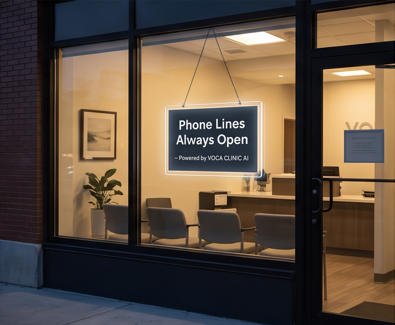
What If Your Dental Office Could Handle More Calls Without Adding More Work?
Running a dental practice is a balancing act.
Your team has patients checking in. Phones are ringing. Someone needs to reschedule an appointment. Another patient has a question about the office. A new patient is calling for the first time.
And somewhere in the middle of all of that, your receptionist is expected to keep everything moving.
The problem isn't necessarily that your team isn't working hard enough.
The problem is that there are only so many things a person can handle at once.
This is where AI voice agents are becoming interesting for dental practices.
Instead of using AI only for complicated clinical applications, practices can use voice AI for something much more practical: handling everyday phone conversations and appointment-related tasks.
And that's a use case dentists are increasingly exploring.
According to the American Dental Association's 2026 data, 43.3% of surveyed dentists are already using AI for at least one task in their practice, while another 26.4% say they plan to use it. The ADA also found that dentists' near-term interest in AI is strongly focused on administrative and efficiency-related work.
So what exactly can an AI voice agent do?

What Is an AI Voice Agent?
An AI voice agent is software that can communicate with people over the phone using natural speech.
Unlike a traditional automated phone menu that says:
Press 1 for appointments. Press 2 for office hours.
a voice agent can have a conversation with the caller.
A patient can explain what they need in their own words, and the AI can respond, ask relevant questions, provide information, and perform supported actions.
For a dental practice, that could mean conversations such as:
- "I'd like to schedule a cleaning."
- "Do you have anything available next Tuesday?"
- "What time do you close?"
- "I'd like to reschedule my appointment."
- "Are you accepting new patients?"
- "I need to speak with someone about my appointment."
Instead of treating every call as an interruption, the practice can use AI to handle the conversations that follow predictable workflows.
The Biggest Advantage: Your Team Gets Its Attention Back
One of the biggest advantages of AI voice agents isn't actually the AI.
It's what your employees can do when they aren't constantly interrupted by the phone.
Think about a receptionist checking in a patient.
The phone rings.
They answer it.
The patient in front of them waits.
Then another call comes in.
Now the receptionist is switching between multiple conversations while trying to keep the front desk moving.
This constant context switching creates unnecessary pressure.
An AI voice agent can take care of appropriate routine calls while your human team focuses on patients who are physically in the office and situations that genuinely require human attention.
That's not replacing your receptionist.
It's reducing the number of things your receptionist has to juggle.

How Effective Are AI Voice Agents?
The answer depends on what you expect them to do.
An AI voice agent isn't a replacement for every conversation that happens in a dental practice.
It is most effective when it is given clear, repeatable workflows.
Appointment scheduling is a good example.
A patient wants an appointment.
The system checks available options.
The patient selects a suitable time.
The appointment is booked.
That's a structured process.
The same principle can apply to other routine questions and workflows configured for the practice.
The more clearly defined the workflow, the easier it is for an AI system to perform consistently.
This is also why the goal shouldn't be to make AI responsible for everything.
The goal is to give AI the right jobs.
6 Ways AI Voice Agents Can Help a Dental Practice

Answer Calls
1. When the Team Is Busy
Your front desk shouldn't have to choose between helping the patient standing in front of them and answering every incoming call.
A voice agent can handle appropriate calls when staff are occupied.
That means fewer situations where the phone simply keeps ringing while the team is busy.
2. Provide After-Hours Coverage
Patients don't always call when your office is open.
Someone may want to schedule an appointment after work. Another patient may remember they need a cleaning on Saturday morning.
The ADA itself recommends that practices consider evening or weekend availability when patient demand warrants it.
An AI voice agent can provide a way for practices to maintain phone availability beyond the traditional front-desk schedule.
3. Help Schedule Appointments
Appointment scheduling is one of the most natural applications for voice AI.
In fact, the ADA's 2026 survey found that 9.2% of responding dentists already use AI for appointment scheduling, while another 19.6% currently do not use it but plan to.
That doesn't mean every practice should immediately automate scheduling.
It does show that appointment scheduling is becoming an important area of AI adoption.
4. Reduce Repetitive Questions
Not every call needs a staff member.
Questions about office hours, basic practice information, appointment availability, and other routine topics can consume significant attention when they arrive throughout the day.
AI can handle appropriate repetitive interactions while your staff concentrates on higher-value conversations.
5. Support a Better Patient Experience
Patients don't particularly care whether the person answering the phone is human or AI.
They care about whether they can get the help they need:
- Can they reach the practice?
- Can they get an answer?
- Can they schedule an appointment?
- Can they get help without waiting indefinitely?
For a patient, convenient access can be just as important as the technology behind it.
6. Help Practices Scale Without Immediately Scaling Phone Work
Adding another location, increasing patient volume, or extending office hours can increase the number of calls your team needs to handle.
AI voice technology gives practices another option: increase phone-handling capacity through software rather than immediately adding another person to every shift.
That doesn't eliminate the need for staff.
It gives the practice another layer of capacity.
Does AI Voice AI Really Reduce Front-Desk Work?
It can but only when implemented correctly.
The mistake is to think:
"Let's make AI answer every call."
A better approach is:
Let's identify which calls are consuming our team's time and determine which ones AI can safely handle.
For example:
AI handles:
- Routine questions
- Appointment requests
- Scheduling workflows
- Basic practice information
- Appropriate after-hours calls
Human team handles:
- Complex patient situations
- Sensitive conversations
- Clinical questions
- Exceptions
- Situations requiring professional judgment
This division creates something more useful than automation for the sake of automation.
It creates human + AI collaboration.
And that's consistent with where dentists appear most comfortable with AI. The ADA's 2026 research shows significantly greater openness toward administrative applications than toward AI making treatment recommendations.
What About Patients Who Don't Want to Talk to AI?

That's a legitimate concern.
Not every patient will want the same experience.
Some patients will happily schedule an appointment with a voice agent.
Others will want a person.
That's why a good dental AI receptionist shouldn't be designed as a wall between patients and staff.
It should provide a useful first layer and allow appropriate conversations to reach a human.
The objective isn't:
"Make patients talk to AI."
The objective is:
"Give patients another way to get help when they need it."
Can an AI Voice Agent Replace a Dental Receptionist?
No! and that's the wrong benchmark.
A dental receptionist does much more than answer phones.
They interact with patients face-to-face, coordinate with the clinical team, manage unexpected situations, handle sensitive conversations, and contribute to the personality of the practice.
An AI voice agent cannot replace all of that.
What it can do is take responsibility for specific phone-based workflows.
That distinction is important.
The best question isn't:
"Can AI replace my receptionist?"
It's:
"Which parts of my receptionist's workload don't actually require a human?"
That's where the business case becomes much more interesting.
What About Accuracy and Safety?
This is one of the most important questions practices should ask before adopting any AI receptionist.
A dental practice shouldn't choose a voice AI system simply because it sounds human.
It should ask:
- What can the system actually do?
- What information does it have access to?
- How does it handle unexpected questions?
- When does it involve a human?
- How are appointments booked?
- How is patient information handled?
- What integrations are available?
- Can the practice control what the AI says?
- Can conversations be reviewed when necessary?
AI should be implemented around clearly defined workflows, appropriate safeguards, and human oversight.
The ADA similarly emphasizes the importance of safety, efficacy, transparency, and fairness when evaluating AI systems in dentistry.
So Where Does VOCA CLINIC Fit?
This is exactly the problem we're building VOCA CLINIC to solve.
VOCA CLINIC is an AI receptionist built specifically for dental practices.
Instead of giving a dental office a generic chatbot and asking the staff to figure out what to do with it, our focus is the phone.
Patients call. VOCA CLINIC answers. Conversations happen. Appointments can be scheduled.
The goal is straightforward:
Help dental practices provide better phone coverage without putting more pressure on their front desk.
VOCA CLINIC can help handle inbound patient calls, answer routine questions, provide appointment assistance, and remain available outside normal office hours.
Our current scheduling workflow connects to an API-based booking system, while deeper dental practice-management integrations are part of our product roadmap.
And we're building specifically around the reality of dental practices.
Because a dental office doesn't need another piece of technology that creates more work.
It needs technology that removes work.
Better Technology Should Feel Like Less Work
That's ultimately how we think about AI voice agents at VOCA CLINIC.
The success of an AI receptionist shouldn't be measured by how impressive the technology sounds.
It should be measured by what happens to the practice afterward.
- Are fewer calls left unanswered?
- Does the front desk have fewer repetitive conversations?
- Can patients get help outside normal office hours?
- Can patients schedule appointments more conveniently?
- Does the team have more time to focus on the patients already in the office?
Those are the outcomes that matter.
AI voice agents aren't here to make dental practices less human.
They're an opportunity to let humans spend more time being human.
And for a busy dental practice, that may be the most valuable application of AI yet.
Ready to See What an AI Receptionist Could Do for Your Practice?
If your dental team is spending too much time answering routine calls, handling appointment requests, or managing phones after hours, VOCA CLINIC can help.
See how an AI receptionist can fit into your dental practice's workflow.
Explore VOCA CLINIC →