AI Receptionist for Dental Offices: Your Second Front Desk, Not Your Replacement
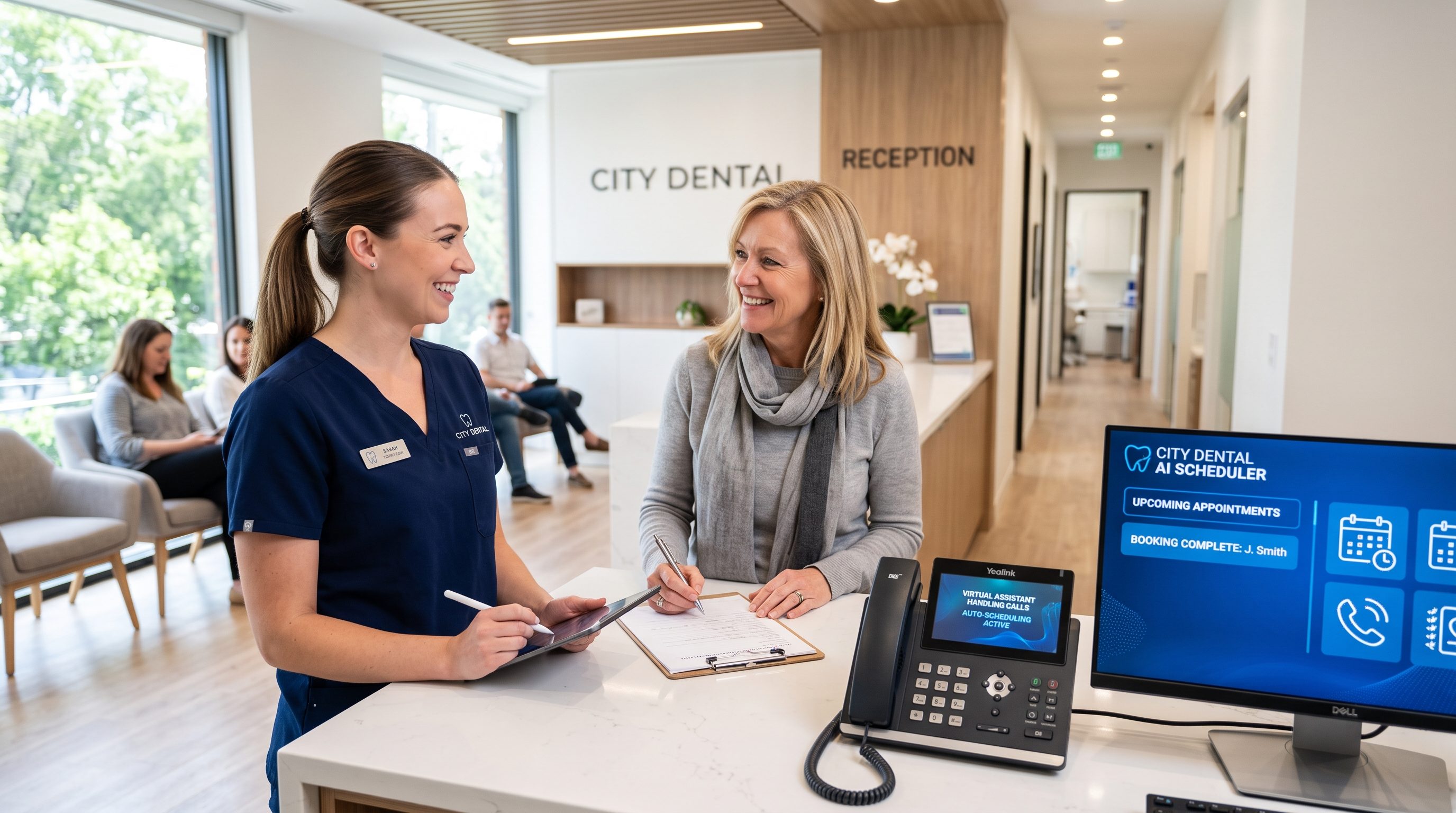
Picture a normal Tuesday at a dental office.
A patient is standing at the front desk checking in.
The phone rings.
Your receptionist answers.
While they're on the phone, another patient walks up.
Then another call comes in.
Someone needs to reschedule.
A hygienist needs help.
And suddenly, the person responsible for answering the phone is doing five jobs at once.
This isn't a problem with your receptionist.
It's a problem with the job.
A dental front desk isn't just a phone-answering position. It's the control center of the practice.
That's where an AI receptionist for dental offices can become surprisingly useful—not as a replacement for your team, but as an extra layer of support.
Think of AI as Your Second Front Desk
The easiest way to understand an AI dental receptionist is to stop thinking of it as a chatbot.
Think of it as a second front-desk employee who never needs to put a caller on hold because someone walked into the office.
It can answer routine calls, provide information about the practice, handle common scheduling requests, and help patients find an appointment.
And unlike a human receptionist, it doesn't have to choose between answering the phone and helping the patient standing in front of it.
That distinction matters.
The American Dental Association's 2026 Health Policy Institute data shows that appointment scheduling and front-desk functions are among the leading areas where dentists who plan to adopt AI are looking to use it.
The industry isn't asking whether AI belongs in the dental office anymore.
The more useful question is:
Which parts of the front desk should AI actually handle?
Start With the Calls Your Team Doesn't Need to Handle Personally
Not every phone call requires a human.
A patient asking:
- "What time do you close?"
- "Are you accepting new patients?"
- "I'd like to schedule a cleaning."
- "Can I move my appointment to next week?"
- "What services does your office offer?"
doesn't necessarily need your receptionist to stop what they're doing.
These are structured conversations.
And structured conversations are where AI voice technology can be useful.
A dental AI receptionist can handle these routine interactions while your staff concentrates on the conversations that genuinely need a human.
That's the important distinction.
AI shouldn't replace the front desk. It should protect the front desk from unnecessary interruptions.
What Happens When the Phone Rings After Hours?
This is where having an AI receptionist becomes even more interesting.
Your practice might close at 5:00 PM.
Your patients don't necessarily stop calling at 5:00.
Someone might search for a dentist at 7:30 PM after getting home from work. Another patient might remember they need to schedule a cleaning on Saturday morning.
Traditionally, that call goes to voicemail.
With an AI receptionist, the conversation doesn't necessarily have to end there.
The patient can interact with your virtual receptionist, ask routine questions, and potentially book an appointment without waiting until Monday morning.
That creates a different kind of patient experience:
The practice may be closed, but the front door isn't completely closed.
And Your Human Team Gets Something Back
There's another benefit that doesn't get discussed enough.
It's not just about answering more calls.
It's about giving your staff their attention back.
Imagine your receptionist doesn't have to interrupt a check-in every time the phone rings.
Imagine fewer repetitive calls asking about office hours.
Imagine not starting Monday morning with a voicemail box full of appointment requests.
That's where dental front desk automation can become valuable.
The goal isn't to remove people from the process.
It's to let people spend more time doing the things people are better at.
Where Should AI Stop?
This is just as important as what AI can do.
A good AI receptionist should know when a conversation needs a human.
Clinical questions, complicated patient situations, sensitive conversations, and situations requiring professional judgment shouldn't be treated like simple scheduling requests.
AI is good at structured, repeatable workflows.
Your team is still essential for everything that requires judgment, empathy, clinical expertise, or a personal touch.
The best setup isn't:
AI vs. receptionist.
It's:
AI + receptionist.
This Is What We're Building at VOCA CLINIC
At VOCA CLINIC, we're building an AI receptionist specifically for dental practices.
The idea is simple:
Give your dental office another pair of ears without hiring another full-time receptionist.
VOCA CLINIC can answer inbound calls 24/7, handle routine patient conversations, and help patients book appointments.
Our current scheduling setup uses an API-connected booking system, with deeper dental practice-management integrations being part of the product roadmap.
And we're intentionally building around dental workflows—not simply taking a generic AI phone bot and putting a dental logo on it.
Because answering a phone call is only the beginning.
The real value is what happens during the conversation.
Your Front Desk Doesn't Need to Do Everything
Technology doesn't have to replace the people who make your practice feel human.
Sometimes, the smartest use of technology is simply removing the repetitive work that keeps those people from doing their best work.
Your receptionist should be able to help the patient standing in front of them.
Your AI receptionist can handle the phone ringing in the background.
That's the model we're building toward at VOCA CLINIC.
If your dental practice is looking for a way to provide 24/7 phone coverage and automate appointment calls without adding another person to the front desk, we'd love to show you how it works.
Book a free VOCA CLINIC demo →
Frequently Asked Questions
What is an AI receptionist for a dental office?
An AI receptionist is a voice-based system that can answer patient phone calls, handle routine questions, and assist with appointment scheduling. Unlike a traditional voicemail system, it can have an actual conversation with the caller.
Can an AI receptionist book dental appointments?
Yes. An AI receptionist can connect to a scheduling system and use available appointment information to help patients book appointments. The exact capabilities depend on the scheduling and practice-management systems being used.
Will an AI receptionist replace my dental receptionist?
It doesn't have to. The strongest use case is often as a support layer for the existing front desk—handling routine and overflow calls so staff can focus on patients and situations that require human attention.
Can an AI dental receptionist answer calls after hours?
Yes. A major use case for an AI receptionist is providing phone coverage outside normal office hours, including evenings and weekends.
Is an AI receptionist worth it for a dental practice?
It depends on the practice's call volume, staffing situation, appointment demand, and current phone workflow. A useful first step is to measure how many calls your practice receives, when they occur, and which calls could be handled without a staff member.